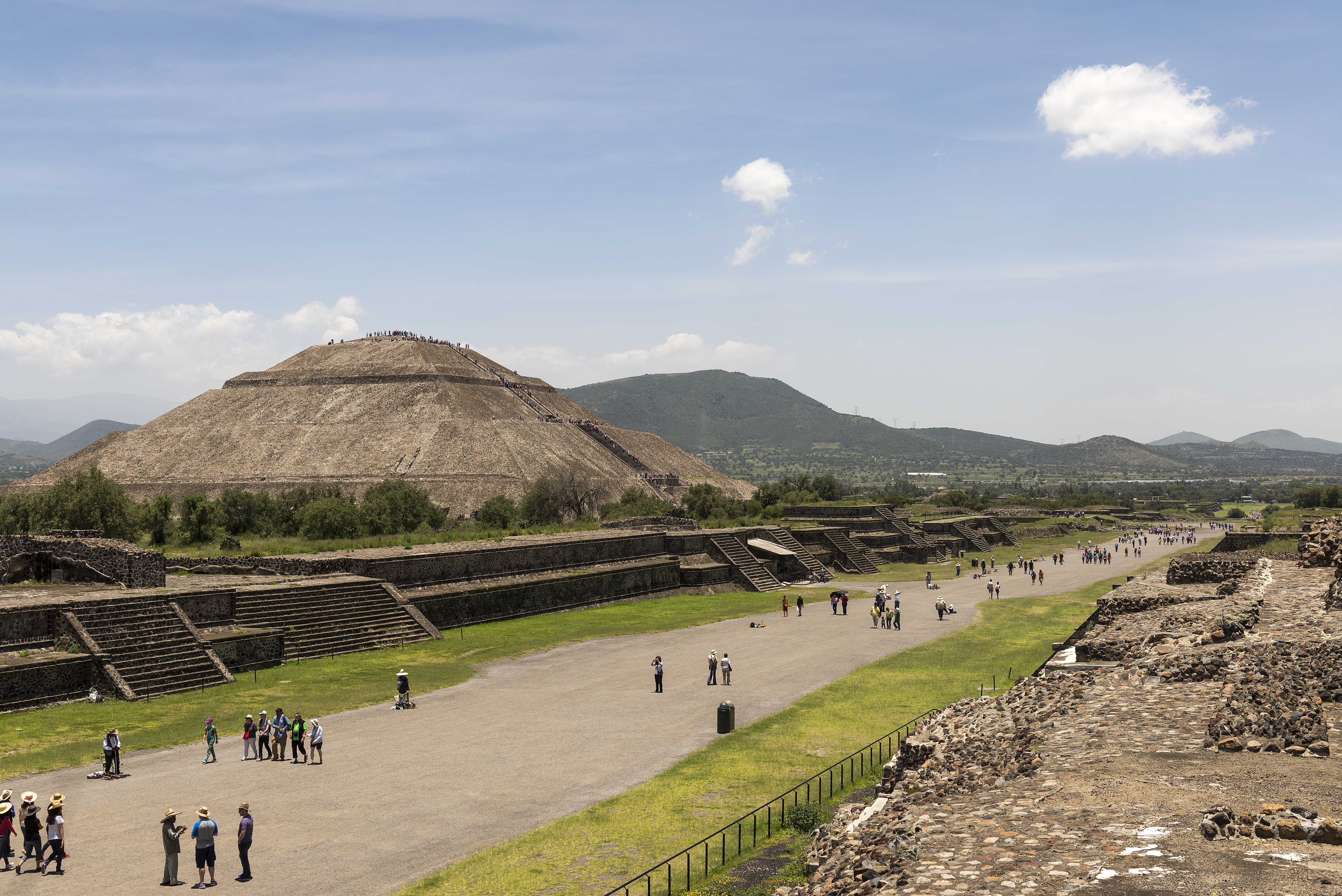
Teotihuacán sits roughly 40km northeast of Mexico City, about an hour's drive, and it's genuinely one of the most complete pre-Columbian sites accessible as a same-day trip from any major city in the world. The Pyramid of the Sun and Pyramid of the Moon anchor the site, connected by the Avenue of the Dead, a processional route stretching more than two kilometers through what was once one of the largest cities in the ancient Americas — at its peak, likely home to more people than contemporary Rome. Nobody knows for certain who built it; it predates the Aztecs, who found the city already ancient and abandoned when they arrived, and gave it the name it carries today, meaning roughly "the place where the gods were created."
Getting there independently is straightforward and cheap. Buses run from Mexico City's Terminal de Autobuses del Norte roughly every 15-30 minutes between 6am and 6pm, operated by Autobuses Teotihuacán specifically — look for their counter inside the terminal. A one-way ticket runs 50-60 pesos, the trip itself takes 1-1.5 hours, and the bus drops you directly at the site entrance. A taxi or rideshare covers the same distance faster, in around an hour, for roughly 500-600 pesos each way.
Plan for the full day even though the drive itself is short: budget 3-4 hours at the site to see the pyramids, the smaller structures, and the on-site museum properly, which means a full round trip — travel plus time on-site — runs close to 6 hours total. Guided tours typically depart early, 6-8am, picking up from a hotel or central meeting point, which has the advantage of getting you to the pyramids before the heat and crowds build. If you'd rather go independently, a skip-the-line ticket bought in advance lets you explore at your own pace for as long as you like within opening hours.
Climbing the Pyramid of the Sun is still permitted and remains the single most memorable part of most visitors' day — the view from the top takes in the entire site and the surrounding valley. Bring water, sun protection, and comfortable shoes regardless of how you get there; there's minimal shade across most of the site, and the walk between the two main pyramids alone covers real distance.
Why it's special
Most "day trip from the capital" recommendations in big cities involve some compromise — a smaller, secondary site, or something genuinely worth seeing but clearly not the headline attraction. Teotihuacán isn't that. This is one of the largest and most significant ancient cities anywhere in the world, built by a civilization whose name we still don't actually know, later found already ancient and mysterious by the Aztecs themselves. Getting to stand on top of the Pyramid of the Sun, looking down an avenue built for a city that once rivaled ancient Rome in population, is a genuinely different order of experience than a typical big-city day trip — and the fact that it's an hour from your hotel, reachable by a $2 bus ticket, makes it one of the most accessible world-class sites anywhere.