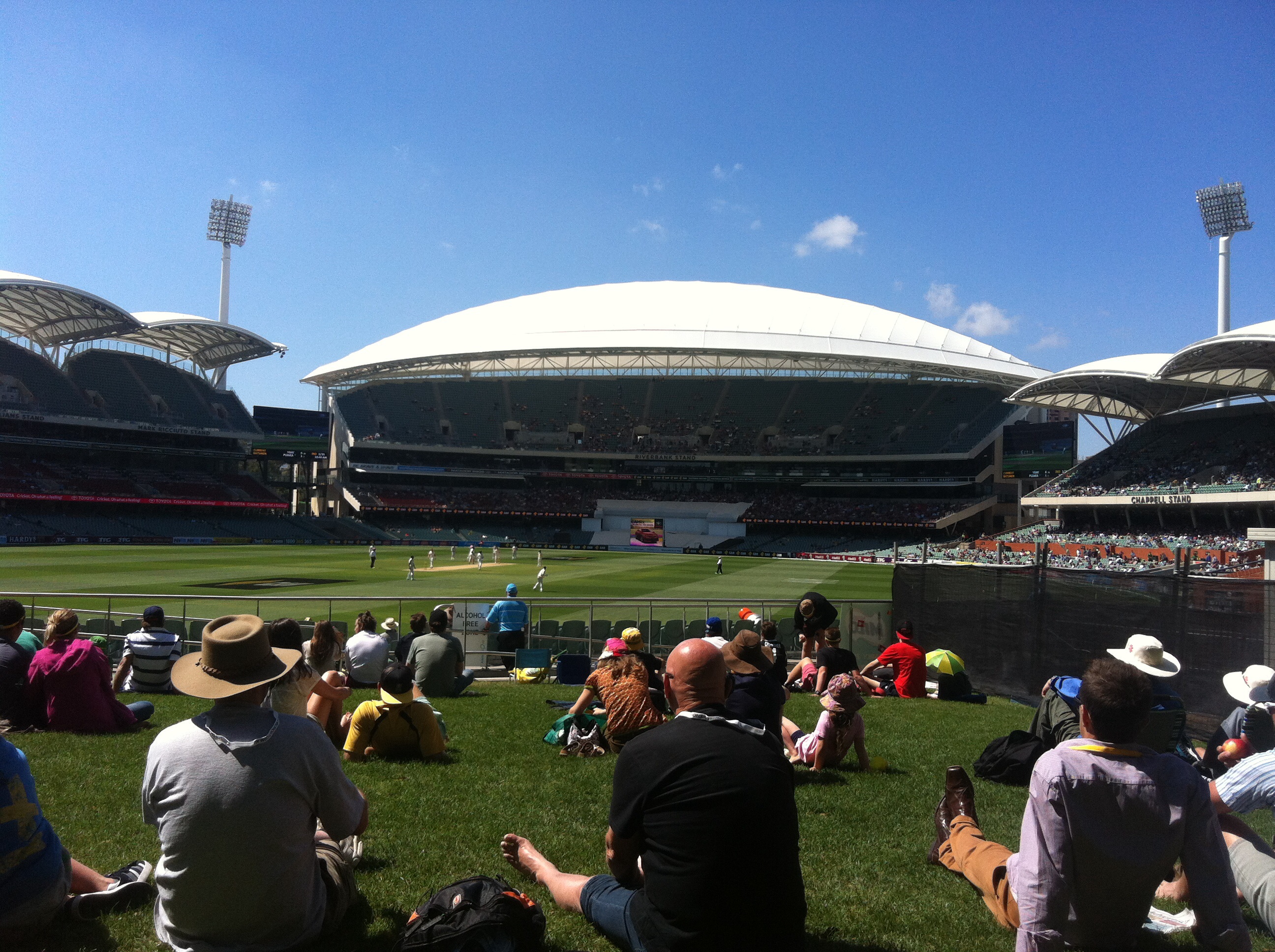
The Hill is Adelaide Oval's answer to the question every modern stadium redevelopment eventually asks: what do you keep? When the ground doubled in capacity in 2014, the old grass mound on the northern side survived as the Northern Mound Terrace — still commonly called the Hill — a timber-decked, shaded standing and casual-seating area beneath the heritage scoreboard and a line of Moreton Bay fig trees, holding roughly 3,500 people. It's general admission, first-come-first-served, and genuinely the cheapest way into a Test match here. The trade-off is real: no chairs allowed, no glass or cans (you can buy a drink inside but not bring one in), and you're standing or sitting on a rug rather than in a fixed seat, which for a full five-day Test is a different proposition than for a single T20.
The Reserve — the Western Grandstand's roughly 14,000 seats, plus the Riverbank and Eastern stands on the opposite side — is fixed, ticketed seating with a guaranteed spot, and the character shifts depending on which side you're on. Square-on seats, roughly side-on to the pitch, give the widest view of field placings and are generally rated the best angle for reading a Test match as a tactical contest. Seats behind the bowler's arm, when available, let you see genuine line and length as the ball is released — prized by anyone who actually wants to judge the bowling rather than just watch the outcome. The long-on/long-off ends trade some of that clarity for atmosphere and a better view of anything hit in the air.
Both options share the same basic physics: Adelaide Oval's redevelopment was explicit about keeping every seat with a genuine view of the ground, so even back-row Reserve seats aren't the write-off they'd be at some older stadiums — but the last row and the extreme corners are still the ones locals say to avoid if you have any choice. Shade matters here too. The Hill sits under real trees and picks up natural shade through the afternoon; large parts of the Western and Riverbank stands are also covered, while some open sections on the Eastern side get full sun for a Southern Australian summer's harshest hours.
For this series specifically, Adelaide is the second Test, played entirely in daylight — no pink ball, no evening session — so whichever side you choose, you're watching a full daytime match rather than planning around a twilight start.
Why it's special
Most Australian grounds gave up their old standing terraces decades ago in favour of an all-seated bowl. Adelaide Oval didn't, and the Hill's survival through a $535 million redevelopment says something real about what this ground values — a cricket crowd that can still turn up with a rug and watch from grass under actual trees, the way generations of Adelaide fans always have, for a fraction of grandstand pricing. That's not nostalgia dressed up as marketing; it's still exactly how a genuine slice of the Test-day crowd here chooses to watch. The Reserve side gives you the opposite: certainty, a specific seat, a specific angle on the game, and for a five-day Test where you might be in the same spot across multiple sessions, that certainty is worth something the Hill can't offer. Neither is the "correct" answer — which one you'd pick says more about what kind of day at the cricket you actually want.