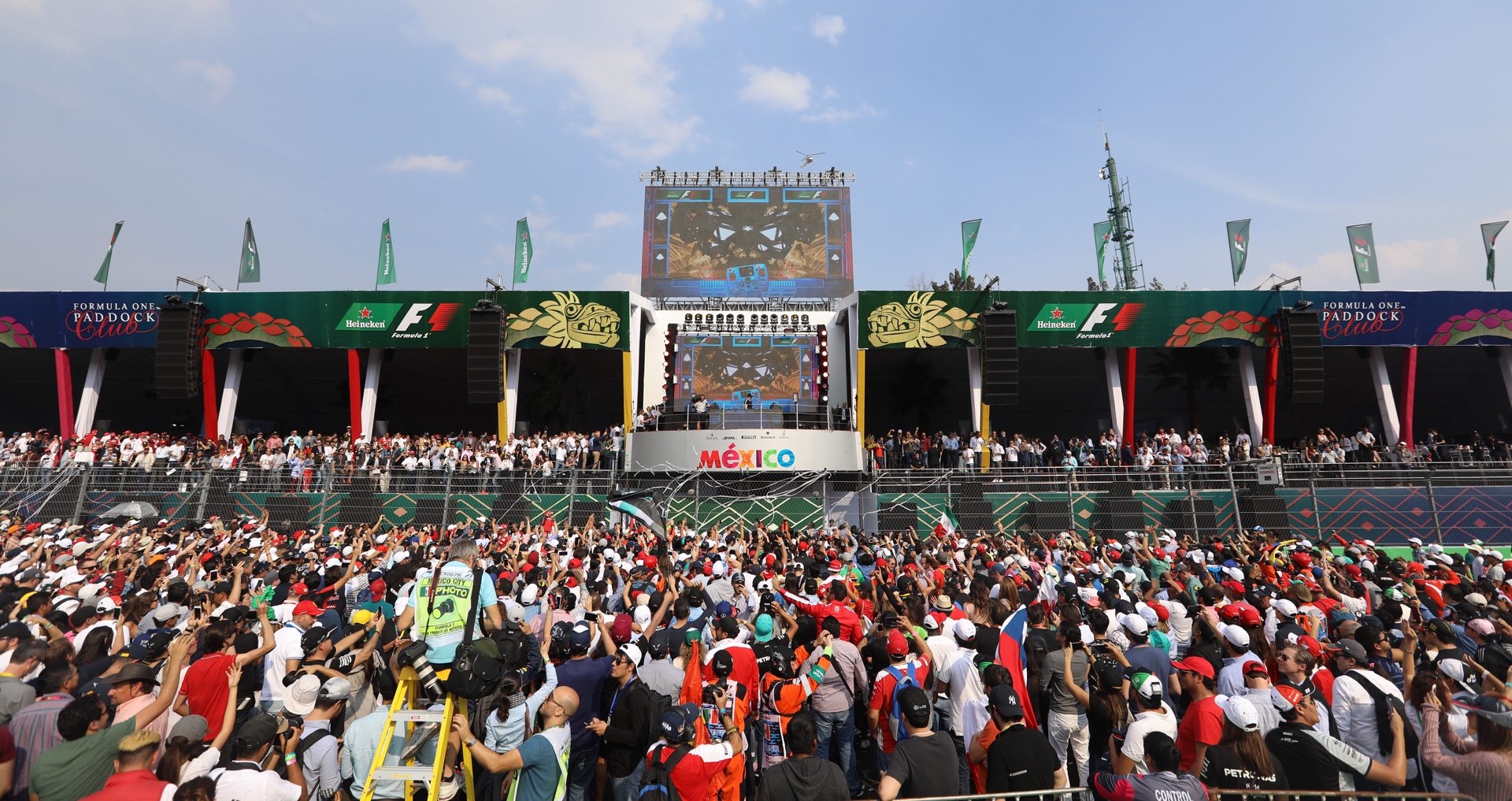
The Autódromo Hermanos Rodríguez opened in 1959 inside the Magdalena Mixhuca public sports complex, and it still sits there today — which is part of why this circuit doesn't feel like a purpose-built racing facility the way Silverstone or Spa do. When F1 returned in 2015 after a redesign, the track's final sector was cut straight through Foro Sol, a baseball stadium built on the site in the 1990s — nowhere else on the calendar does a Grand Prix run through a venue built for a completely different sport.
Where each zone actually sits
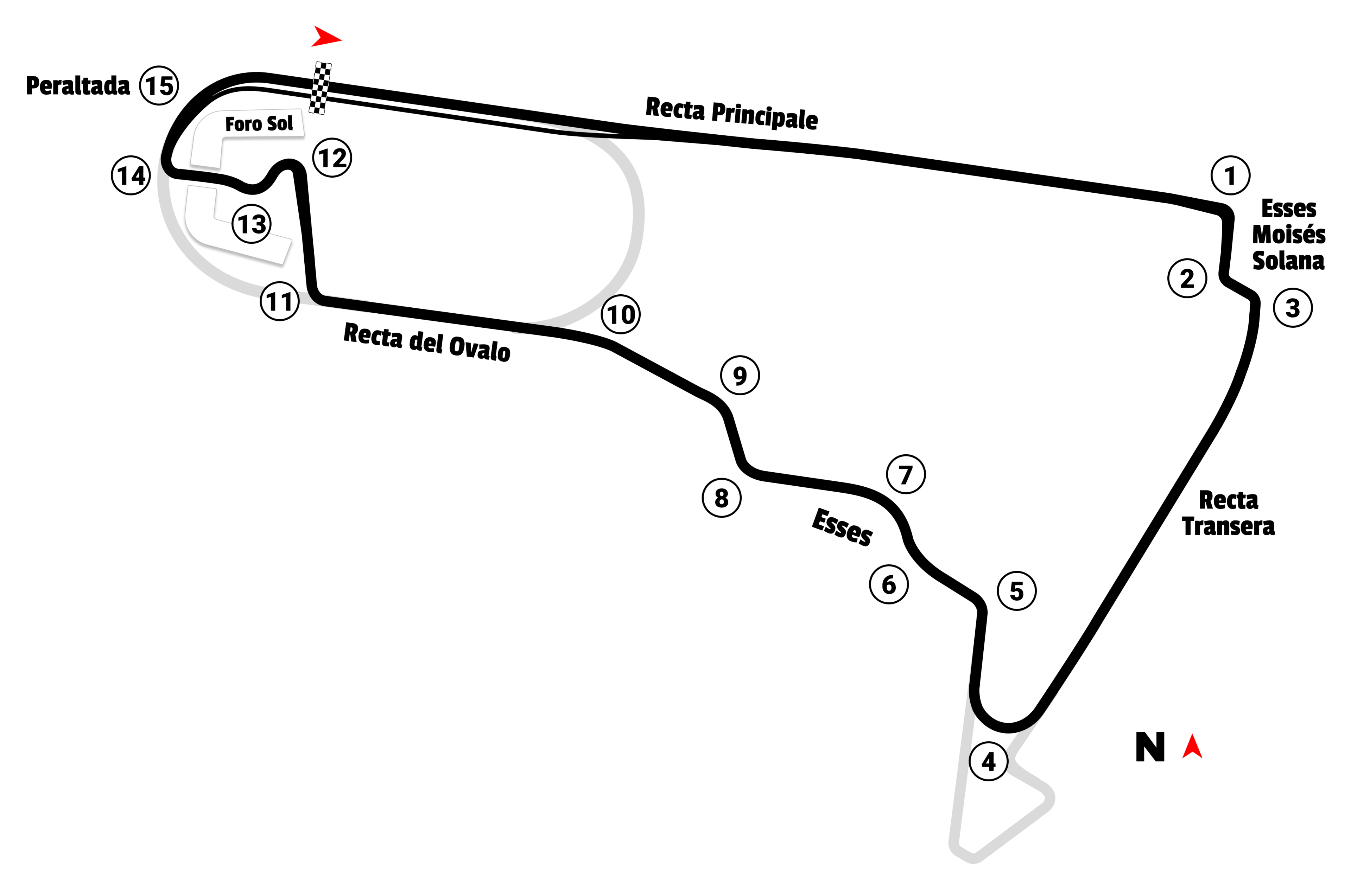
Map: Wikimedia Commons, WL2392, CC BY 4.0.
The Blue Zone (Grandstands 3-6) lines the run from the start/finish straight through turns 1-3, where cars brake from over 300kph for the first corner — this is where the real racing and overtaking happens. Grandstand 12 (Yellow Zone) covers the slower, technical turns 4-6, with a partial roof over the top rows — one of the only sections offering real shade. Foro Sol (Grandstands 14 and 15, Grey and Brown Zones) forms the stadium section at turns 12-15, where the track threads between what was once a baseball diamond — slower corners, but the loudest, most atmospheric part of the circuit, and the site of the podium ceremony. General admission areas and most remaining grandstands are fully uncovered.
On-site facilities
The Fan Zone
Included with any race ticket, no separate purchase — driver and team principal appearances, F1 simulators, a Pit Stop Challenge, and cultural programming that leans harder into local mariachi and folk-dance performances than most other Grands Prix.
Food & drink — cashless only, no outside food
More than 50 food options run across temporary stalls and food trucks — tacos, seafood, pizza, churros, and more — but you can't bring your own food or drink onto the circuit, and every purchase goes through the Citibanamex Cashless card system rather than cash-in-hand. Load the card before you're actually hungry. Beer is sold 11:00-19:00 and spirits 12:00-19:00; up to 12 free water stations are spread across the fan zones if you just need to refill.
No pass-outs
Once you leave the circuit, you can't re-enter that same day — treat this as a one-way gate for the full session, not a venue you can duck out of for a break.
Accessibility
Designated accessible seating sits in the Green Zone and Blue Zone specifically, with accessible facilities built into those areas — worth confirming directly with the ticketing team if this matters to your booking, since it's not evenly spread across every grandstand.
Phone signal on race day
Mobile networks genuinely struggle under race-weekend crowds, Sunday worst of all — agree a physical meeting point with anyone you might get separated from rather than counting on being able to call or message them.
Noise — bring earplugs if you're close to the track
The standard grandstands are loud but manageable; anywhere genuinely close to the cars is not, and earplugs are a real, practical add rather than overcaution — worth it for kids specifically.
Getting between zones
Because the circuit sits inside a working public sports complex rather than a facility built solely for racing, large parts of the race-weekend infrastructure — stages, some food areas, fan zone structures — are temporary builds rather than permanent fixtures. Follow the Metro station matched to your specific gate (see the Getting There guide) to reach your zone directly, rather than crossing the venue on foot from a different entrance.
What we'd actually check before buying
If racing action is the priority, confirm your grandstand sits in the Blue Zone (turns 1-3) before buying — the seating chart alone doesn't always make this obvious. If you specifically want the Foro Sol atmosphere, understand you're trading racing quality for crowd energy, not getting both; neither Foro Sol stand gets you close to the pit lane or paddock, so if garage proximity matters, look at Grandstands 1 and 2 on the front straight instead.