Free

What facilities are available at Melbourne Park?

Three roofed arenas, dozens of outside courts, one 5-10 minute walking radius

Melbourne Park is compact by Grand Slam standards — every major arena sits within a 5-10 minute walk of every other, so a day spent moving between show courts and the outside courts doesn't cost much time in transit.

Site layout

Rod Laver Arena

The main show court since 1988, retractable roof — the tournament's marquee venue

Margaret Court Arena

Second show court, its own retractable roof, own separate ticket

John Cain Arena

Third roofed venue, general admission grounds access on some tickets, own reserved seating on others

Show Court 3

Included with a Rod Laver Arena reserved seat, alongside every outside court

Outside Courts 3-15

No reserved seating — walk-up only, included with any Ground Pass or higher ticket
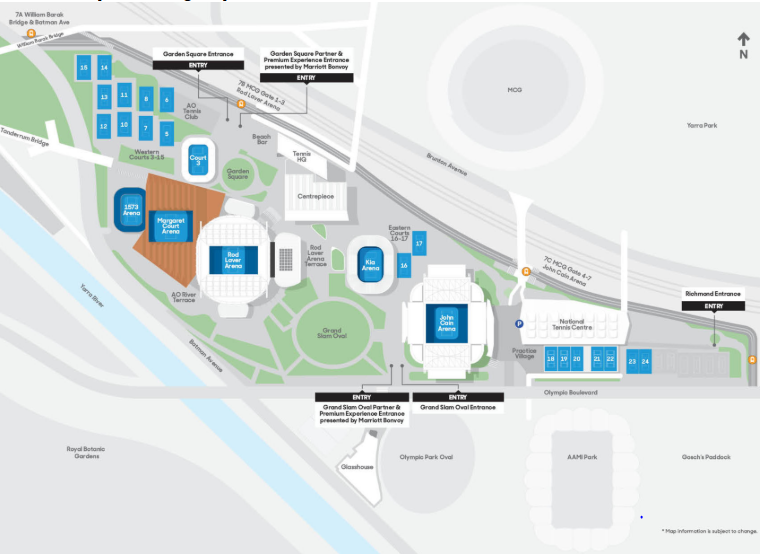
Melbourne Park precinct map showing Rod Laver Arena, Margaret Court Arena, John Cain Arena, and the outside courts

Map: austadiums.com

Rod Laver Arena — Inside the Main Show Court

Rod Laver Arena — Inside the Main Show Court

4.7(7,876 Google reviews)

The world's first retractable-roof tennis arena, and still the Open's main stage after 39 years

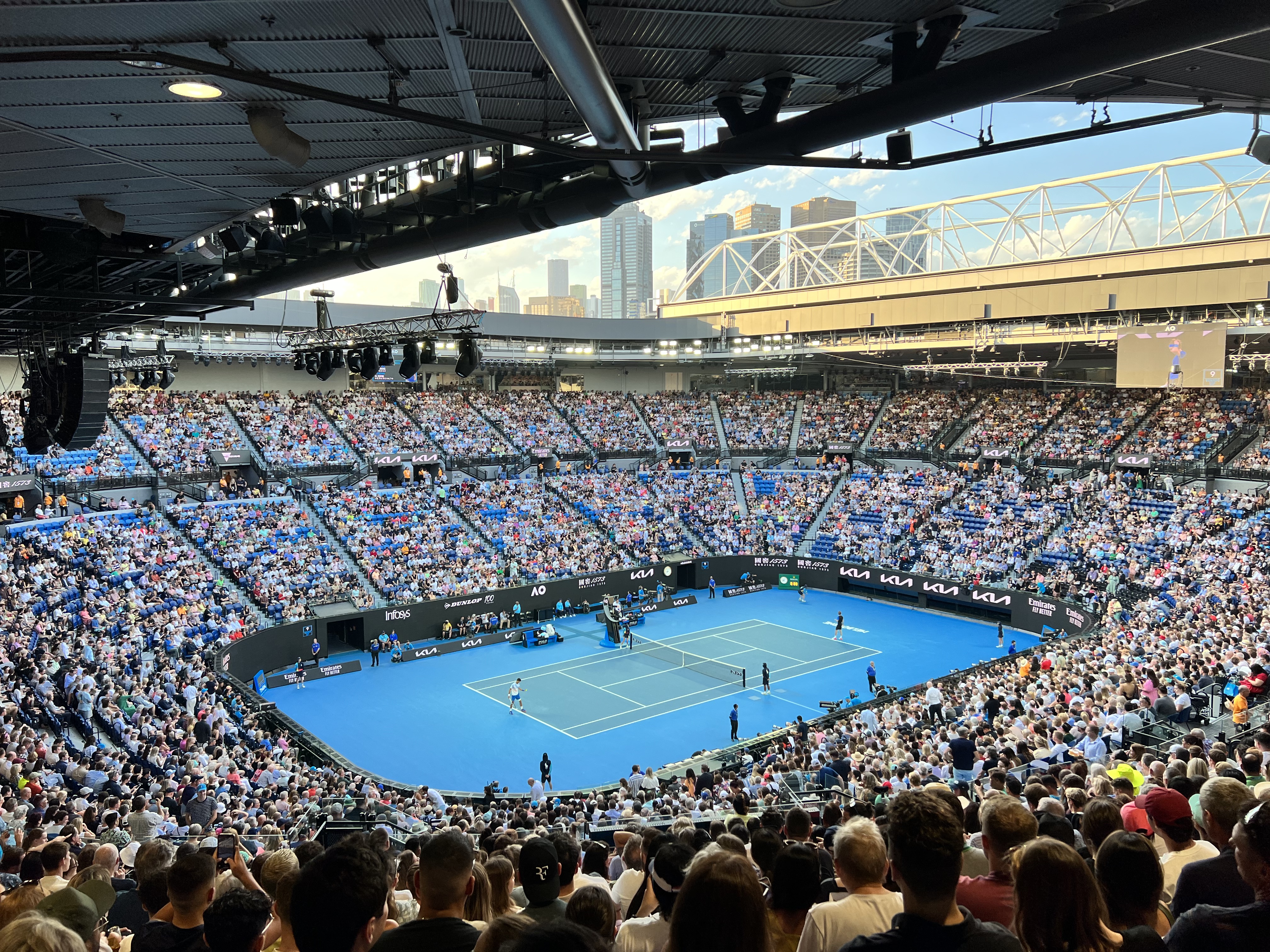
Most Grand Slam venues are defined by tradition. Rod Laver Arena is defined by an engineering decision — the retractable roof that made the "Happy Slam" possible in the first place, since without it the tournament would still be at the mercy of Melbourne's summer storms and 40°C heat spikes the way it was through the 1970s and early 80s at Kooyong. That's not incidental atmosphere, it's the structural reason this tournament runs the way it does. I find the arena's age more interesting than its scale: this is the same bowl where Laver's own legacy got its name in 2000, where Australia last lifted the Davis Cup on home soil, and where every Australian Open final since 1988 has been decided. Watching a night match here means watching it in the one building purpose-built to guarantee the match actually finishes. It is loud, steep, and specific in a way that generic "grand slam arena" copy never quite captures — you feel the 1988 engineering every time that roof closes over your head mid-rally.

Melbourne Park

Worth knowing

  • Get to your seat 20-30 minutes before a night session starts if the roof is forecast to close — the closure itself pauses play and draws a crowd to the concourse screens, and latecomers miss the moment.
  • The Australian Tennis Hall of Fame busts in Garden Square are free to view any time the grounds are open, no ticket required beyond a grounds pass — worth the five-minute detour on the way in.
  • Seats in the lower bowl put you closer to the net than the roof height suggests from outside photos — the arena's steep rake means even mid-tier rows have a clean sightline to both ends of the court.
Margaret Court Arena & John Cain Arena

Margaret Court Arena & John Cain Arena

The two other roofed courts — where second-week tennis is often better than the price tag suggests

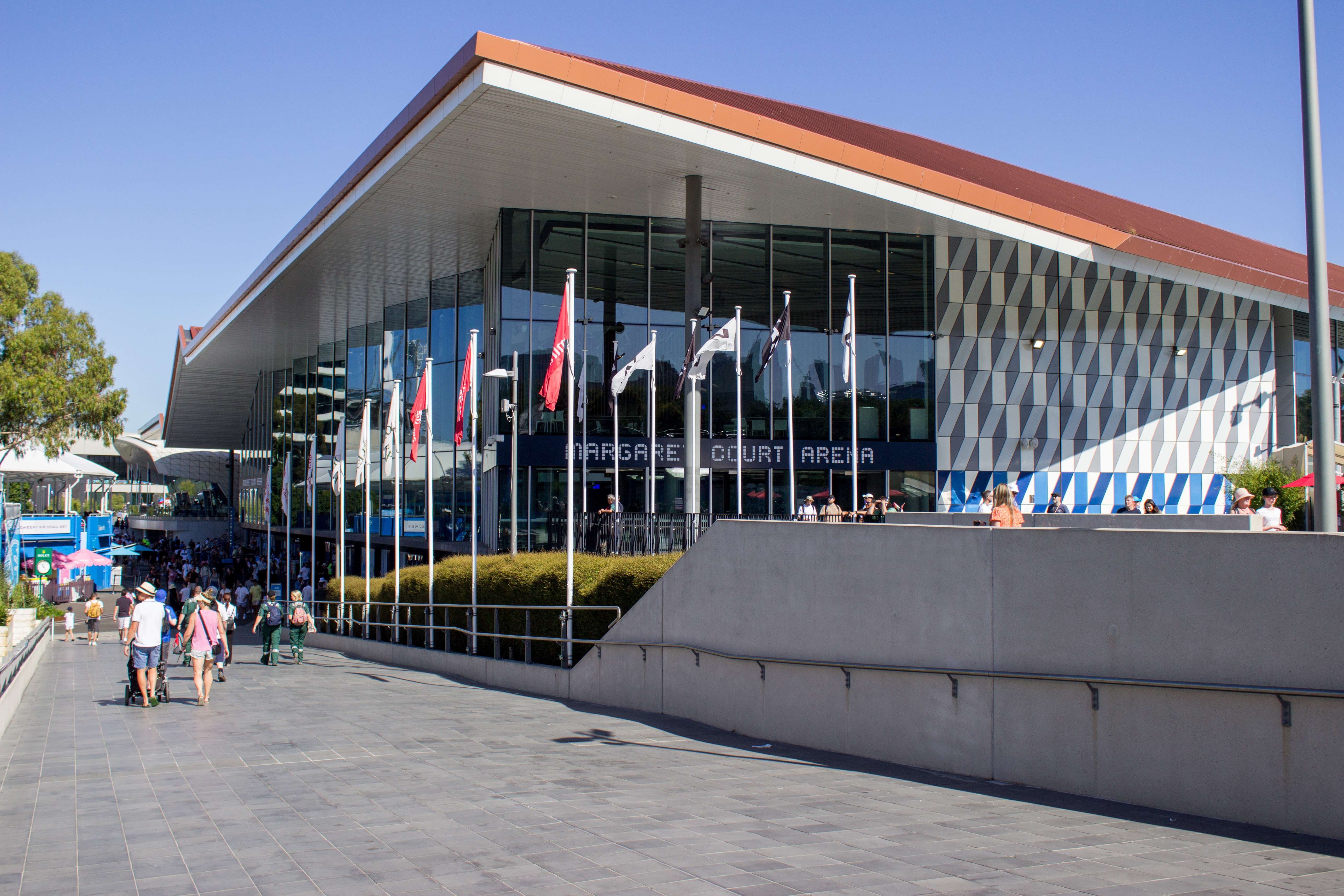
Rod Laver Arena is where the Open puts its biggest matches, but Margaret Court and John Cain are where you're more likely to see genuinely close tennis without the premium price tag. I'd rather sit in Margaret Court Arena for a fourth-round match between two players I've actually heard of than pay Rod Laver prices for an early-round mismatch. The roofed-court system itself is what makes this whole event weather-proof, and it's worth remembering that took two separate multi-year building projects to get right: MCA's own retractable roof wasn't finished until 2014, decades after Rod Laver's. John Cain's four names in twenty years is its own small piece of Melbourne politics and sponsorship history, and its current name is the one that actually sticks, a rare case of an Australian venue landing on a public figure's name instead of a corporate one and keeping it. None of this is background trivia, it's the reason you can walk between three genuinely different, genuinely good tennis experiences in one afternoon without ever leaving the same few hundred meters of Melbourne Park.

Melbourne Park

Worth knowing

  • A Rod Laver Arena reserved seat does not include Margaret Court Arena — Margaret Court needs a separate reserved ticket entirely, but is usually cheaper and easier to get for evening sessions with popular second-week matches.
  • John Cain Arena tends to schedule doubles and wheelchair events during the day session — check the daily order of play rather than assuming it's only singles overflow.
  • MCA's roof closes faster than Rod Laver's original design did, so a rain delay there tends to resolve quicker if you're deciding whether to wait it out or move to another court.

Facilities across the grounds

Food and drink

Grand Slam Oval and the food village between Rod Laver and Margaret Court Arena carry real Melbourne restaurant names, not just stadium catering — see the Where to Eat guide.

Ticket-tier entry

A Rod Laver Arena reserved ticket also covers John Cain Arena, Show Court 3, and every outside court on the same day — but not Margaret Court Arena, which needs its own separate ticket regardless of what else you're holding.

A first-timer's guide to the outside courts

Numbered courts 3-15 are the cheapest, most flexible way to see close-up tennis at the Open — no reserved seat, walk up and sit wherever there's room. See the Ticket Guide for the real grounds-pass strategy.

Facilities & accessibility

Step-free throughout the precinct

Melbourne Park is built for it — ramps, lifts, wide entry gates, and priority access lanes at every main entrance. Rod Laver, Margaret Court, and John Cain Arenas all have dedicated wheelchair seating, ease-of-access seating for limited mobility, enhanced-vision seating, and seating near hearing loops.

Accessible toilets

Located near Doors 3, 13, 16, and 20 at Rod Laver Arena, plus inside Railyards and the Upper Deck — and throughout the wider grounds, not only near accessible-seating entrances.

Sensory rooms

Dedicated sensory rooms at AO Ballpark, John Cain Arena, Margaret Court Arena, and Rod Laver Arena, plus complimentary sensory kits and communication boards at information points.

Hearing loops and live captions

Hearing loops are fitted in key venues, and live captions run on screens around Melbourne Park during the tournament.

Booking accessible tickets and a Companion Card seat

Accessible tickets can only be bought through the AO Accessibility Line on 1300 308 999 (Mon-Sun, 9am-5pm AEDT) or by emailing [email protected] — not through general sale. A current Companion Card is required for a Companion Card ticket, and you'll need to carry it with you at entry.

Source: ausopen.com/accessibility, Ticketmaster Australia accessible ticketing.