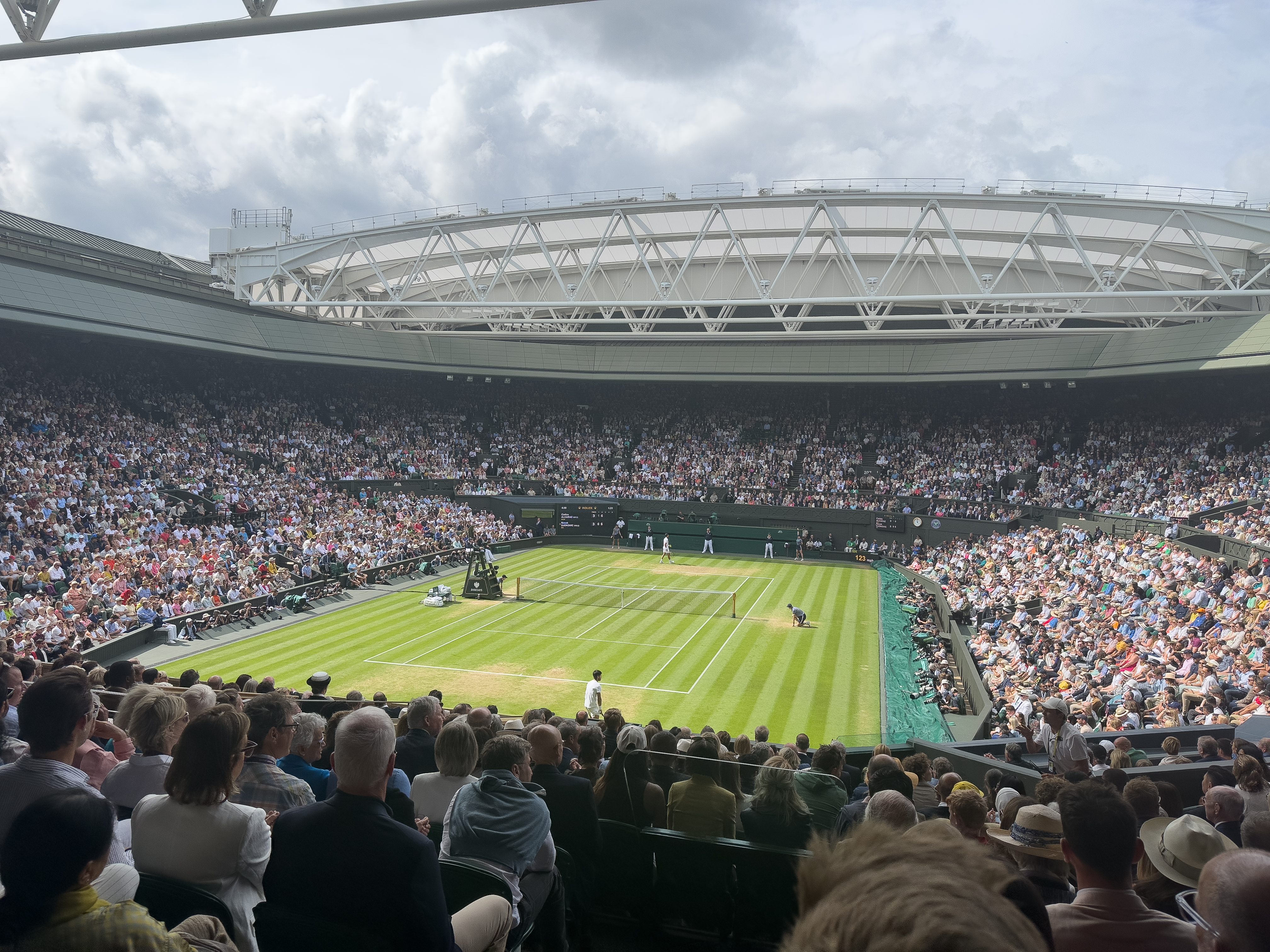
The All England Club charges £30 for a Grounds Pass on Day 1. What you get for that is access to the grounds, the outer courts, and — if you find a spot on the grass bank at Aorangi Terrace — an afternoon of Centre Court tennis on a screen roughly the size of a bus.
The Hill sits north of Court 1, gently sloping. On most days during The Championships, the screen broadcasts whatever is happening on Centre Court live. You can't hear the commentary from the back rows without headphones plugged into the Wimbledon app, but you don't especially need it. The crowd on the Hill responds to what it sees. A break of serve passes round the slope within seconds.
What makes this different from a pub screening, or a sports bar, or any other communal watching arrangement, is where you're sitting. You're on the actual Wimbledon grass, inside the actual grounds, watching actual matches played roughly two hundred metres away. The gap between the Hill and Centre Court is thin in physical terms. In atmosphere, there's no gap at all.
People bring blankets and folding chairs. Carrier bags full of Pimm's and plastic cups. Someone always has a punnet of strawberries. By the first week of July, SW19 has a very specific smell — the grass, the berries, something warm and faintly fizzy — and you get it most strongly here.
The queuing logic matters. Grounds Passes go on sale from around 9am at Gate 3 on Church Road. There's no online purchase option — you show up. Position roughly 2,000 in the queue is where ground passes typically start running out on peak first-week days. Once inside, the Hill fills from about 11am onward. If you arrive midday on a busy day you'll find yourself toward the rear, which is still fine — the screen is large and angle matters less than you'd expect.
The Club's bag size limit (40cm x 30cm x 30cm) is enforced at the gates without exceptions. Folding chairs are allowed if they collapse within the limit. Large rucksacks won't get through. If you're planning a full afternoon — and you should — pack everything before you leave home.
Most people on The Hill aren't watching one match intently. They're talking, eating, half-watching, and then suddenly leaning forward because something is happening on the screen. When the scoreline tightens in a third set between two players the crowd didn't know they cared about, the whole bank goes quiet together. That particular collective attention — the way it spreads without anyone deciding it should — is worth understanding before it happens to you.
The Hill is not a consolation for people who couldn't get Centre Court tickets. It's a different experience. You're on the grass, in the sun, surrounded by people who made the same calculation: that being there is worth something separate from whether you have a numbered seat. The players don't know you're watching. The Hill always knows.