There is a particular quality to arriving at Lord's on a match day. The tube at St John's Wood empties onto the street and you join a slow procession south along the tree-lined approach. Five minutes, maybe less. Flags and food vendors appear as you get closer. Then the ground itself — brick and Portland stone — comes into view, and whatever you thought you knew about cricket grounds gets recalibrated.
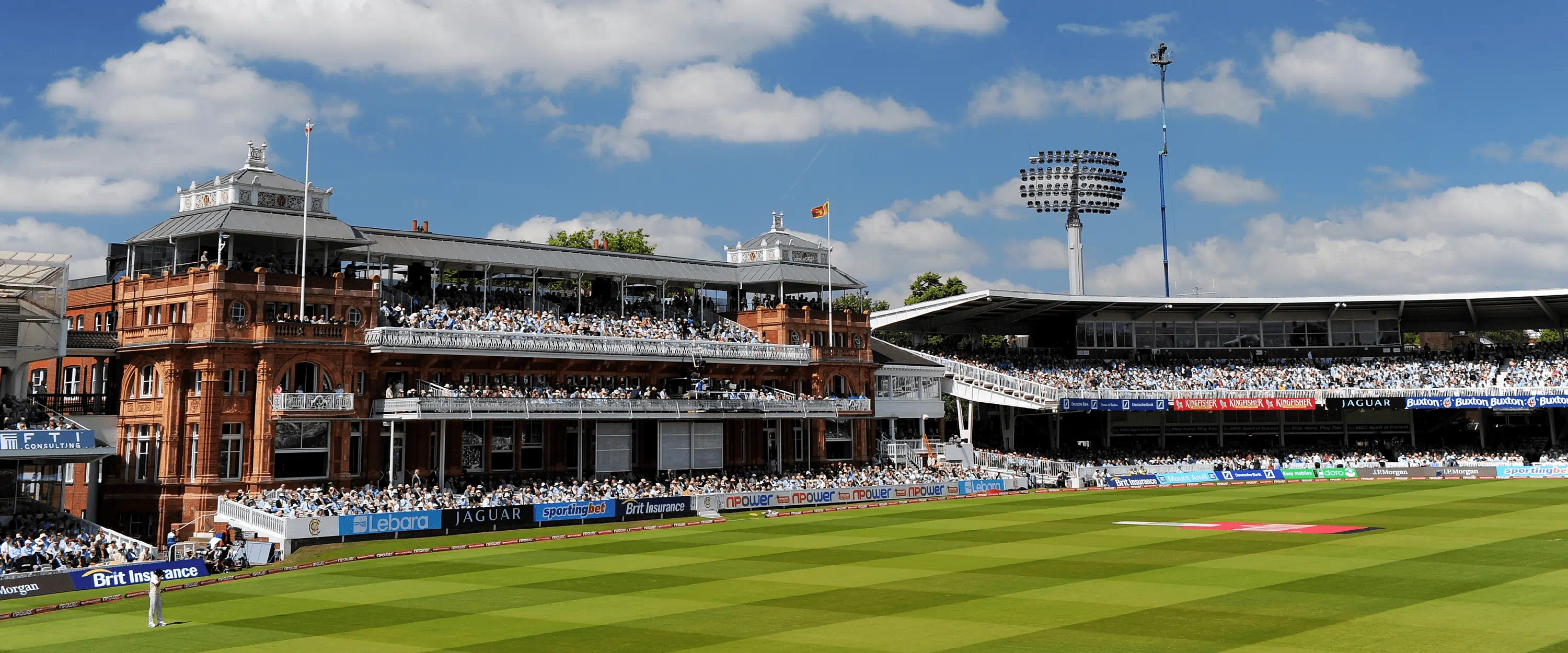
Lord's has been a cricket ground since 1814. It has been the home of the MCC — the Marylebone Cricket Club — since 1787, back when the club was still playing on what is now Dorset Square. The Pavilion standing at the western end of the ground was built in 1889. The Long Room inside it, through which every England and touring batter walks from the dressing rooms to the pitch, is lined with portraits of cricketers stretching back to the 18th century. W.G. Grace hangs there. So does Bradman. The MCC members stand at the Long Room windows watching play, in their scarlet-and-gold egg-and-bacon ties, and occasionally offer comment to departing batters on the quality of their dismissal.
Non-members sit in the Compton Stand, the Edrich Stand, the Tavern Stand, and the Mound Stand. The Pavilion is members only — the waiting list for full MCC membership currently runs to about 27 years. This is not a complaint. Part of what makes Lord's interesting is the coexistence: the Long Room members, the open-stand crowd, and, on India match days, the Bharat Army somewhere in between.
For the 3rd ODI on 19 July 2026, the series arrives at Lord's having already been played through Nottingham, Manchester, Bristol, Southampton, and Birmingham. If the series is level, this is the decider. Either way, it is the last day, and Lord's tends to make last days feel significant.
The Media Centre at the Nursery End is worth a proper look from the outfield — a white aluminium pod on two concrete legs, hovering 15 metres above the ground, built by a boat-yard in Falmouth and craned into place in sections in 1999. It won the Stirling Prize that year. From the playing surface it looks improbable, which is precisely the point: a Victorian ground, a Victorian Pavilion, and a spacecraft parked at the other end.
The MCC Cricket Museum is free with a match ticket for international fixtures. The original Ashes urn is there — smaller than most people expect. So is Bradman's bat. The collection documents cricket from the 1700s and is one of the oldest sporting museums in the world. It is worth arriving early enough to spend twenty minutes inside before play starts.
Gates open for non-members at 9am. The match begins at 11. The walk from St John's Wood tube takes under ten minutes at a match-day pace. Note: the ongoing Tavern and Allen Stand redevelopment means the Grace Gates may not be the active entrance in 2026 — check lords.org before the day for the current non-member entry point.
The Sunday fixture, the final match of the tour, will run until the early evening. July in London can be anything. Lord's is exposed on all sides and the ground catches whatever the day is doing.
Why it's special
Most grounds become significant through what happens in them. Lord's is one of the few that carries weight before a ball is bowled.
Walking into it — through whichever gate they're using this year — and seeing the Pavilion at one end and the Media Centre at the other is a specific experience. The ground is not attempting to be modern, and it is not attempting to be preserved. It is simply itself, which takes about 200 years of continuous use to achieve.
For an India match, that setting gets a second layer. The Bharat Army are vocal from early in the day. Chants of Jai Hind and Ganpati Bappa Morya roll around the Compton and Edrich stands. In 2021, when India beat England here by 151 runs and the match ran over India's Independence Day, the flags in the stands were as much about August 15th as they were about cricket. Lord's absorbed all of it without fuss — it has been absorbing things for two centuries — and the result was a day of cricket that felt genuinely historic.
That is what the combination produces: a ground that lends gravity to whatever is played in it, and a crowd that, for an India fixture, brings something closer to a celebration than a sporting event. The MCC blazers stay in the Long Room. The Bharat Army are in the stands. The cricket is happening in between, in one of the most unusual amphitheatres in sport.
Insider tips
- 1
The MCC Cricket Museum is free with your match ticket for international fixtures — arrive before 10am to spend time there before play starts, it becomes crowded at lunch.
- 2
Non-member entry is via the Compton, Edrich, Tavern, or Mound stands — the Pavilion is MCC members only; do not queue at the wrong gate.
- 3
The Grace Gates may not be the active non-member entrance in July 2026 due to ongoing construction — check lords.org a few days before for confirmed entry points.
- 4
Sunday means a full-day fixture running into evening; Lord's is open to the sky with no shelter from the weather, so check the forecast and pack accordingly.
Practical info
- Getting there
- St John's Wood tube (Jubilee line) to St John's Wood Road — under 10 minutes on foot. The 139 and 189 buses stop directly on St John's Wood Road adjacent to the ground. Driving is not recommended; no public parking at the ground and the surrounding streets are tightly controlled on match days.
- Address
- St John's Wood Rd, London NW8 8QN, United Kingdom
What to avoid
Don't arrive at St John's Wood station post-match without a plan — the tube operates a queuing system after Lord's matches and the queue can stretch some distance down Wellington Place. Either leave just before the end of play to avoid it, or take a bus (the 139 and 189 stop directly on St John's Wood Road) or walk north toward Swiss Cottage for a different tube station. During the match, avoid over-ordering at the bars during the innings break — the queues back up quickly and you can miss several overs.