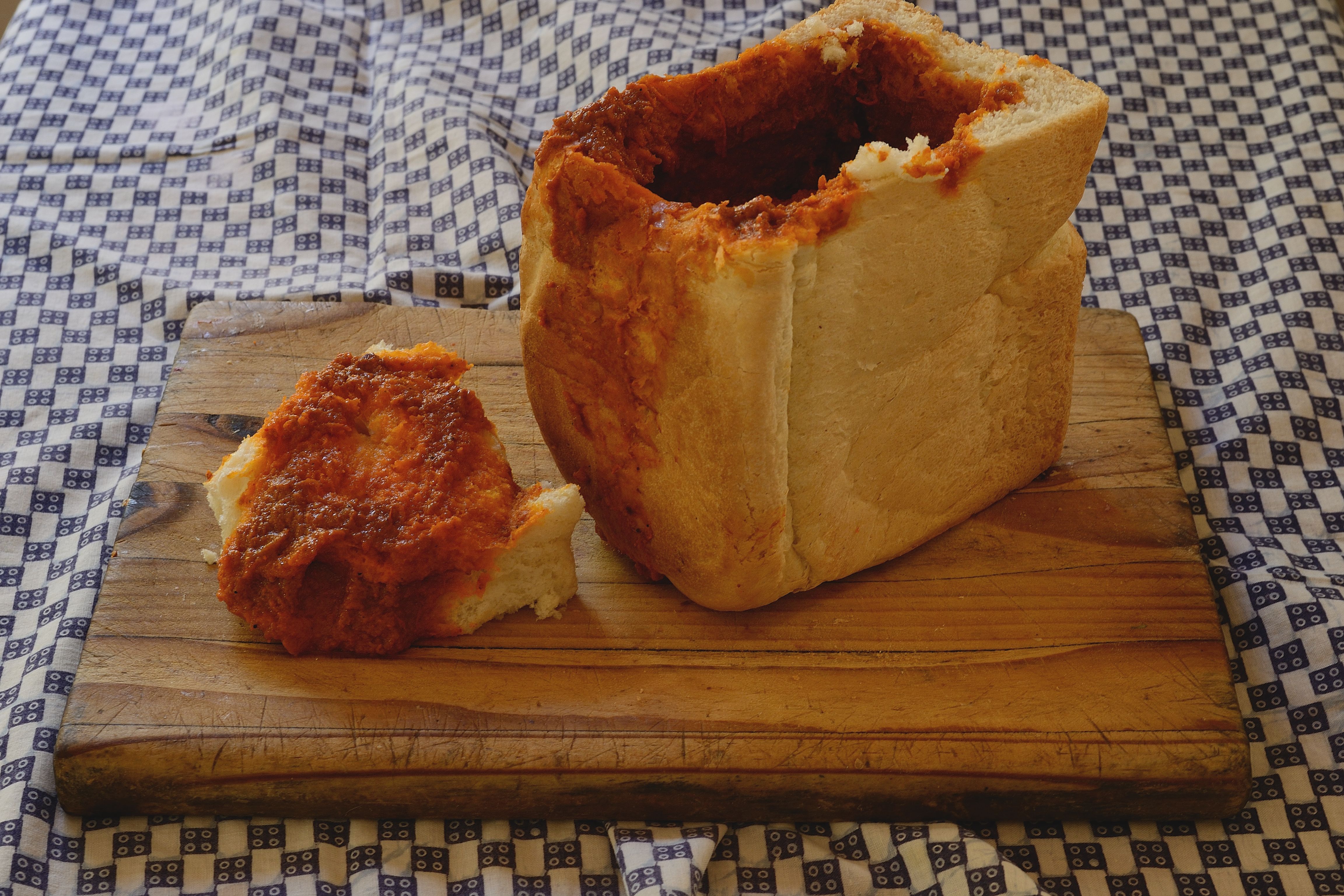
Durban has the largest Indian diaspora outside of India itself, and the city's food culture reflects that history directly rather than as an imported trend. Bunny chow — a hollowed-out loaf of bread filled with curry — is the dish that best represents it, and it was invented in Durban, not brought here fully formed from elsewhere.
The dish's origins trace to Indian indentured labourers and traders in early-to-mid 20th century Durban, who needed a portable, contained way to eat curry without cutlery — the bread became both container and food. It's since become the city's defining street food, sold everywhere from casual takeaway spots to established sit-down restaurants, typically ordered by the "quarter," "half," or "full" loaf depending on how hungry you are, and by filling (mutton, chicken, bean, or vegetable curries are all standard). CaneCutters, with locations in Glenwood and Umhlanga, is one currently-trading spot worth naming directly — a quarter mutton bunny runs around R65-R100 depending on filling, prawn curry included.
Beyond bunny chow specifically, Durban's Indian Ocean cuisine draws on decades of Indian culinary tradition adapted with local ingredients and spice blends distinct from Indian subcontinental cooking — Durban curries tend to run hotter and use different spice combinations than their Indian counterparts, having evolved separately for well over a century. The signature dish beyond bunny chow is Durban king prawn curry, a fiery, tomato-and-spice-heavy preparation that draws on the warm Indian Ocean waters off KwaZulu-Natal, where prawns, crayfish, and line fish are abundant. Several established hotel restaurants along the coast run dedicated curry buffets — a practical way to sample a wide spread of Durban curry styles, from fish to lamb to vegetarian, in one sitting rather than committing to a single dish.
The Victoria Street Market in the CBD is the traditional starting point for understanding this food culture — a covered market selling spices, ingredients, and quick eats that's been part of Durban's Indian community life for generations, worth a visit even if you're eating your actual meals elsewhere.
Why it's special
Durban's food story is genuinely distinct from the rest of South Africa's culinary landscape, and it's easy to miss that if you only think of South African food as braai and boerewors. Bunny chow specifically is a dish that couldn't have been invented anywhere else — it's a direct product of Durban's specific history of indentured Indian labour and the practical need for portable food, not a fusion dish dreamed up for tourists.