What facilities are available at Albert Park?
A 5.278km lakeside circuit that reverts to a running path 361 days a year
Albert Park Grand Prix Circuit wraps 5.278km around Albert Park Lake, three kilometres south of Melbourne's CBD — for 361 days a year it's public roads and parkland, and for one week each April it becomes an FIA Grade 1 circuit with 14 corners and four DRS zones. Because the tarmac is normal road surface rather than a dedicated track laid down once and left, grip actually builds session by session as rubber goes down — which is why Friday's Practice 1 can look scrappy and the same corners suddenly get taken flat by Saturday's Sprint Qualifying.
A circuit with real history
The circuit first hosted a Grand Prix in 1953, was mothballed for decades, and reopened in 1996 as Formula 1's new Australian home after Adelaide lost the race — it's hosted 29 Grands Prix since. The 2021 reprofile straightened and widened several corners for faster, closer racing; the current lap record, 1:19.813, was set by Charles Leclerc in 2024, nearly five seconds quicker than Michael Schumacher's old 2004 mark on the pre-2021 layout. Schumacher remains the most successful individual driver here with four wins; Ferrari leads all constructors with ten. Ayrton Senna won his final Grand Prix here in 1993, six months before his death — a result still replayed every year the race returns. Mark Webber made his F1 debut here in 2002, the first chapter of a career that would eventually earn him his own grandstand at this circuit.
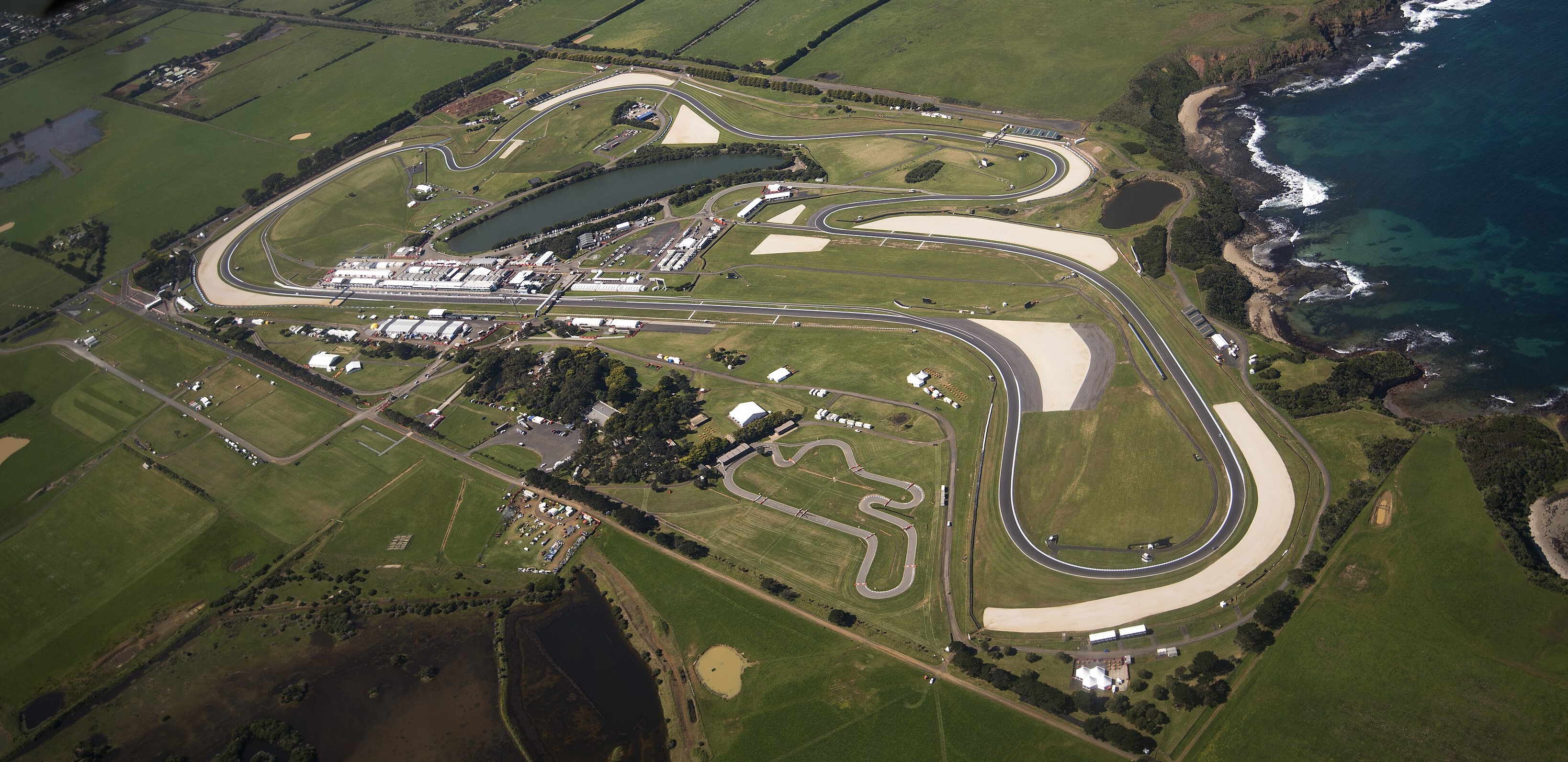
Circuit map
Credit: ausstadiums.com.
Where the racing actually happens
Because the track is genuinely fast by street-circuit standards — long straights, few genuine hairpins — overtaking clusters at specific points: the Turn 1-3 complex off the main straight, and the DRS-enabled Turn 11 exit. First-lap chaos is something of an Albert Park tradition — Martin Brundle's spectacular 1996 opening-lap crash and Ralf Schumacher's airborne 2002 shunt both happened at Turns 1-3, the same complex the Brabham and Jones grandstands now overlook. Knowing that shapes where you choose to watch from as much as any grandstand's proximity to the pits does — see the Ticket Guide for the full grandstand-by-grandstand breakdown.
On-site facilities
No on-site parking
Road closures around the circuit make driving pointless even if you wanted to — the free tram/train system is the only sensible way in. See the Getting There guide for the full route.
No wifi, no ATMs
There's no public wifi inside the venue — download the official Grand Prix app before you leave your hotel. There are no ATMs inside either, so sort a card or cash before you arrive.
Food & drink
You can bring your own food and non-alcoholic drinks in — not alcohol or glass containers, and hard eskies are out while soft coolers and polystyrene eskies are fine. Buying inside runs at genuine event pricing: most proper meals sit A$15-20, a beer around A$12.
Getting between zones
Albert Park's seven gates are spread around a 5km perimeter — know which gate serves your grandstand or entry point before you arrive, since walking from the wrong side of the lake to correct a mistake can cost 20-30 minutes. See the Arrival & Queue Guide for the full gate breakdown.
What we'd actually check before buying
If racing action matters most, confirm your grandstand sits near the Turn 1-3 complex or the Turn 11 DRS zone rather than assuming any main-straight stand gives you the same view — Brabham and Vettel are the two that actually put you on top of the circuit's real overtaking drama. If watching pit stops and the podium matters more, Fangio and Piastri's main-straight position is the better trade.