Why Go
The Mark in the Clay — Why Roland-Garros Still Won't Trust a Machine
Tennis·2 min read·September 7, 2026
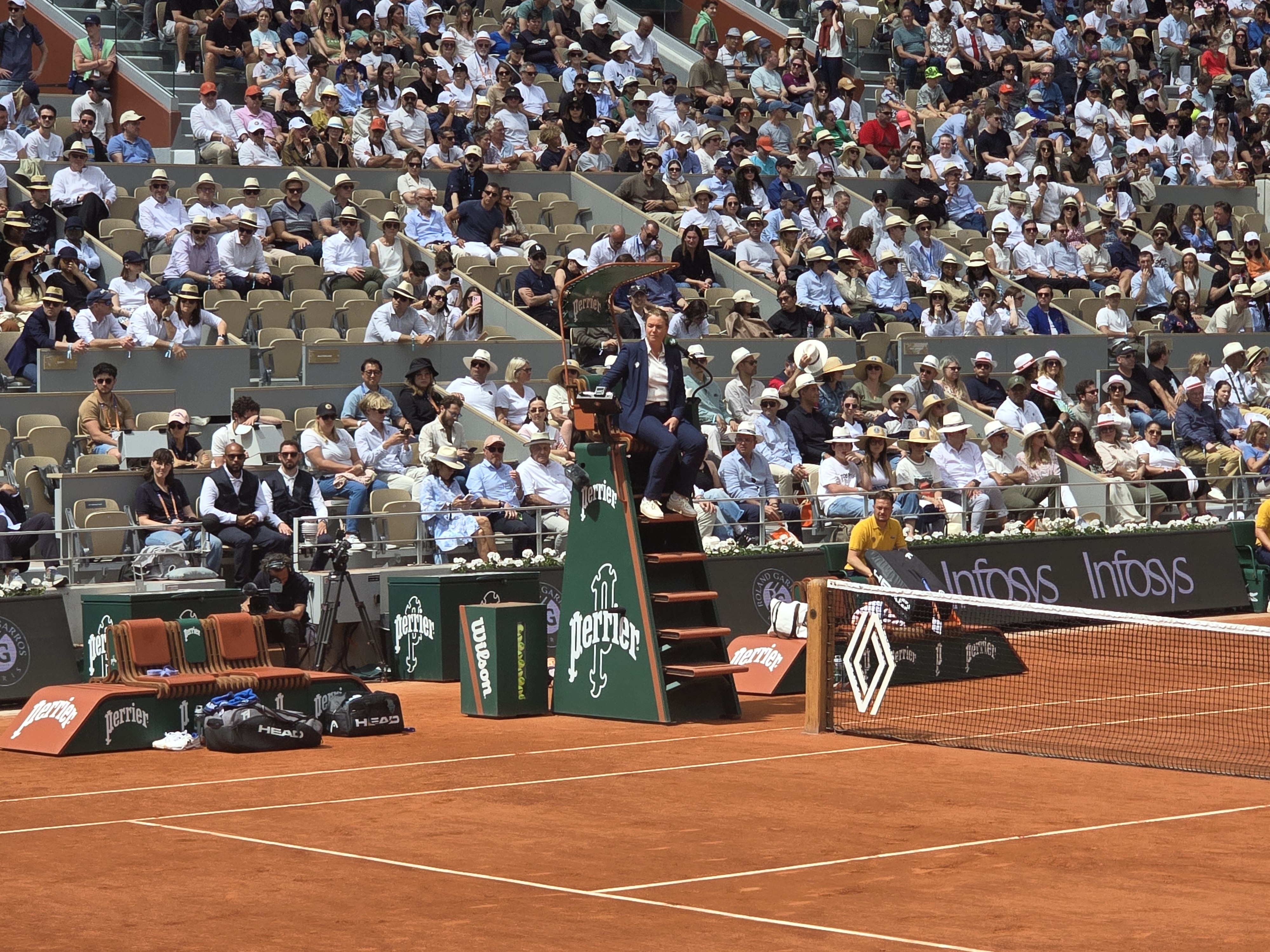
Like tears in rain (Wikimedia Commons, CC BY-SA 4.0)
Every other Grand Slam settled this years ago. The Australian Open dropped line judges for good in 2021. The US Open went fully electronic in 2022. Wimbledon, 147 years of human line judges, switched to Hawk-Eye Live in 2025. Roland-Garros still hasn't, and as of the 2026 tournament, the director in charge says it isn't ready to yet.
What actually happens when a call is questioned
There's no camera system making the final decision here. When a player disputes a call, they walk to the net and point at a mark on the court. The chair umpire can climb down from the chair and look at it — a real, physical smudge left in the clay by the ball on impact — and rule based on what they see. It's the only Grand Slam where a disputed point can still be settled by a person walking over and looking at the ground.
That system produced a real controversy in 2026. Casper Ruud was playing João Fonseca in a second-set tiebreak when a shot that looked out was called in after the umpire checked the mark. Electronic replay later showed the ball had actually landed out — but since Roland-Garros doesn't run that system live, the umpire's call on the mark stood. Ruud lost the set, then the match.
Iga Swiatek had her own version of the same problem in her semifinal loss to Aryna Sabalenka. She asked chair umpire Kader Nouni to come down and check a mark; he didn't, and later explained he felt she'd waited too long to ask and pointed to the wrong spot. Hawk-Eye data afterward confirmed the ball had been out. Swiatek's response was blunt: "I don't think that was fair, especially when he came down, like, every time Aryna asked him to."
Why the tournament is still holding out
Amélie Mauresmo, the tournament director, has given the actual reason directly: "What we observed at the clay-court tournaments leading up to Roland Garros is that the reliability of this system is not absolute. As of today, the machine is not 100 percent reliable, so we continue to place our confidence in human officials." Clay is genuinely harder for electronic tracking than a hard court or grass — dust, irregular bounce, and a surface that changes shape point by point all make it a different technical problem than the one Hawk-Eye already solved everywhere else.
Mauresmo left the door open, but not much more than that: "We've made that choice for 2026. As for 2027, we'll see." Nobody, including the tournament itself, is promising anything different by the time the 2027 edition comes around.
What it means if you're in the stands
This is the one moment at Roland-Garros that can't happen at any other Slam. Watch enough tennis here and you'll eventually see it: a player pointing at a spot on the clay, an umpire stepping down from the chair, a genuine argument settled by two people looking at a mark on the ground instead of a screen. It's slower, it's occasionally wrong, and it's produced real controversy in back-to-back years. It's also the last place in Grand Slam tennis where a line call still comes down to a human being's own eyes.